Compact KNX switching actuator with 2 bistable relay outputs 250V~/10A. Staircase function, heating actuator, integrated logic, KNX Security. 1 DIN module (18 mm). Art. 5444.
Output Devices
Descrizione mancante
The Blind Actuator KNX IO 520 (1J2I) is a compact blind actuator with two additional binary inputs. The actuator is used to control a blind, a shutter or a window drive. The relay contacts are electrically interlocked. The inputs Blind Actuator KNX IO 520 (1J2I) can be connected to conventional switches with an external voltage of 12 to 230 V. In the not configured state the binary inputs control the actuator channel. Via commissioning the device using ETS® software the binary inputs can be used independently. Two push buttons and three LEDs allow a local operation and a visualization of the device state. In addition to the output and input channels the Blind Actuator KNX IO 520 (1J2I) includes 16 independent functions for logic or timer control.
- ▪ 1 shutter output, 230 V∿, 8 A
- ▪ Drive directions electro-mechanically locked against each other
- ▪ For blinds, shutters or window drives
- ▪ Approach position via time calculation
- ▪ 2 inputs 12..230 V⎓∿, galvanically isolated
- ▪ Switching, dimming, shutters, scenes, pulse counter
- ▪ Integrated logic and timer functions
- ▪ Connections: KNX, plugable screw terminals for IO
- ▪ For DIN rail, width 1 unit (18 mm)
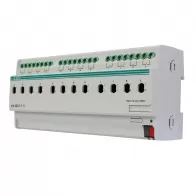
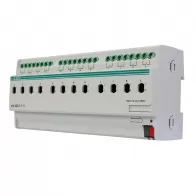
A 12 channel KNX actuatorfor monitoring electrical loads with outputs up to 16A. The device provides the traditional switching functions, complete with notification of the state, stop command, timer functions and scenarios. It also has a set of logical functions consisting of 16 freely configurable communications objects (OR, AND, XOR). The outputs can be pre-set individually by ETS.
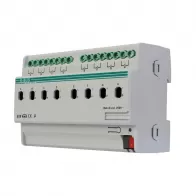
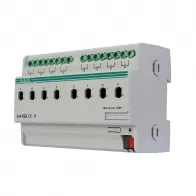
A 8 channel KNX actuatorfor monitoring electrical loads with outputs up to 16A. The device provides the traditional switching functions, complete with notification of the state, stop command, timer functions and scenarios. It also has a set of logical functions consisting of 16 freely configurable communications objects (OR, AND, XOR). The outputs can be pre-set individually by ETS.
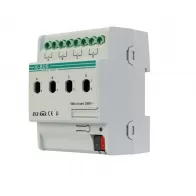
A 4 channel KNX actuatorfor monitoring electrical loads with outputs up to 16A. The device provides the traditional switching functions, complete with notification of the state, stop command, timer functions and scenarios. It also has a set of logical functions consisting of 16 freely configurable communications objects (OR, AND, XOR). The outputs can be pre-set individually by ETS.
- Wireless 1-channel Switch actuator for general purpose.
- Up to 16A switching capacity with non-free voltage output.
Two different operation modes:
· Switch ON/OFF.
· Timer: 3sec ~ 5min. - Incorporates RF signal repeater function, which can be enabled or disabled as needed.
- A conventional pushbutton can be wired for local control.
- DIN-rail mounting. Dimensions: 1 module wide.
- 230V-operated.
- Radio-frequency: 868,4MHz.
- Range: up to 100m (in the free field).
- Compatible with: EM KNX 002, PU KNX 001, RC KNX 001, SE KNX 003, DM KNX 001, DM KNX 002 & CO KNX 002.
In addition to switching resistive loads, SA108 is designed to be used with capacitive and inductive loads, enabling a convenient control of fluorescent ballasts and led drivers.
8 independently configurable channels
Manual control for each relay on the device using slide switches
Does not require an external power supply
Electric current control can be configured
Following functions can be defined separately for each channel:
- Stair function
- External logic
- Internal logic
- Priority function
- Threshold function
- Transaction time
- Sweep function
Download DATASHEET
Download MANUALE
Download DATABASE ETS
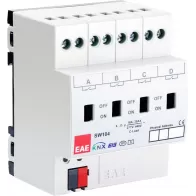
In addition to switching resistive loads, SA104 is designed to be used with capacitive and inductive loads, enabling a convenient control of fluorescent ballasts and led drivers.
4 independently configurable channels
Manual control for each relay on the device using slide switches
Does not require an external power supply
Electric current control can be configured
Following functions can be defined separately for each channel:
- Stair function
- External logic
- Internal logic
- Priority function
- Threshold function
- Transaction time
- Sweep function
Download DATASHEET
Download MANUALE
Download DATABASE ETS
The switch actuators are the modular installation devices, with 2, 8 and 12 outputs for selection, using EIB BUS connection terminals to connect to the system. The switch actuators are connected to the AC power supply directly instead of an extra voltage supply.